 Tempor
GPS Tracking of Employees: What UK Law Actually Allows
"Can I put a tracker on the vans?" is one of the most common questions we get, and the honest answer is more useful than a straight yes or no. Tracking your workers' location is lawful in the UK — but it is lawful conditionally, and most of the employers who get into trouble were not being sinister. They collected more than they needed, kept collecting it after the shift ended, or never told anyone. This article sets out what the rules actually require, where the common failures are, and how to design attendance tracking that survives a complaint.
The short answer
There is no UK law that bans employers from tracking staff by GPS. There is also no law that grants you a general right to do it. What governs it is data protection: a worker's location is personal data, so collecting it is processing under the UK GDPR and the Data Protection Act 2018, and it has to satisfy the same principles as any other processing.
In practice that means the Information Commissioner's Office (ICO) will ask you five questions. If you can answer all five with evidence, you are on solid ground. If you cannot answer them, the technology being "standard in the industry" will not help you.
The five things you have to get right
1. A lawful basis — and it probably isn't consent
You need a lawful basis under Article 6 before you collect anything. The instinctive choice is to ask staff to sign a consent form. That is usually the wrong move.
The ICO's position is that the imbalance of power in an employment relationship means consent is rarely freely given — an employee asked to consent to tracking as a condition of being paid is not really in a position to refuse. Consent also has to be as easy to withdraw as it was to give, which means any worker could opt out tomorrow and you would have to accept it.
Most employers rely on legitimate interests instead. That is a defensible basis, but it is not a free pass: you have to carry out and record a Legitimate Interests Assessment, which is a three-part test.
- Purpose — what is the actual business interest? "Confirming attendance at the site the client is being invoiced for" is a real purpose. "Keeping an eye on people" is not.
- Necessity — is the monitoring genuinely needed to achieve that, or would something less intrusive do the same job?
- Balance — does your interest still hold up against the worker's rights and their reasonable expectations of privacy?
That third limb is where all-day tracking tends to fall over, and it is worth being honest with yourself about it before someone else is.
2. Tell people, before you start
Covert monitoring is exceptional. It is reserved for situations like a genuine suspicion of criminal activity or serious misconduct, needs to be narrowly scoped and time-limited, and should be signed off at a senior level with a clear record of why an open approach would have defeated the purpose. It is not a routine tool.
Everything else has to be transparent, and "transparent" has a specific meaning. Before monitoring starts, workers should be told:
- what is collected, and at what moments it is collected
- why — the specific purpose, not a general one
- the lawful basis you are relying on
- how long it is kept and who it is shared with
- their rights, including the right of access and the right to object
That normally lives in a worker privacy notice plus a short monitoring policy. The ICO also recommends consulting workers before introducing monitoring — not merely announcing it. That is guidance rather than a hard legal duty, but it is cheap to do, and a workforce that was asked first complains a great deal less than one that discovered it.
3. Do a DPIA
A Data Protection Impact Assessment is required where processing is likely to result in a high risk to people's rights, and systematic monitoring of workers' location sits squarely in that territory. The ICO's monitoring workers guidance, finalised in October 2023, goes further and says employers should complete one before any worker monitoring, even where it is not strictly mandatory.
Treat this as useful rather than bureaucratic. A DPIA is the document that forces you to write down what you are collecting and why — which is exactly what you will be asked for if a worker complains, and exactly what you will not be able to reconstruct convincingly after the fact.
4. Collect the least that does the job
Data minimisation is a principle, not a nicety. You are required to collect what is adequate, relevant and limited to what is necessary. So the question is never "what can this device capture?" — it is "what is the smallest amount of data that answers my actual question?"
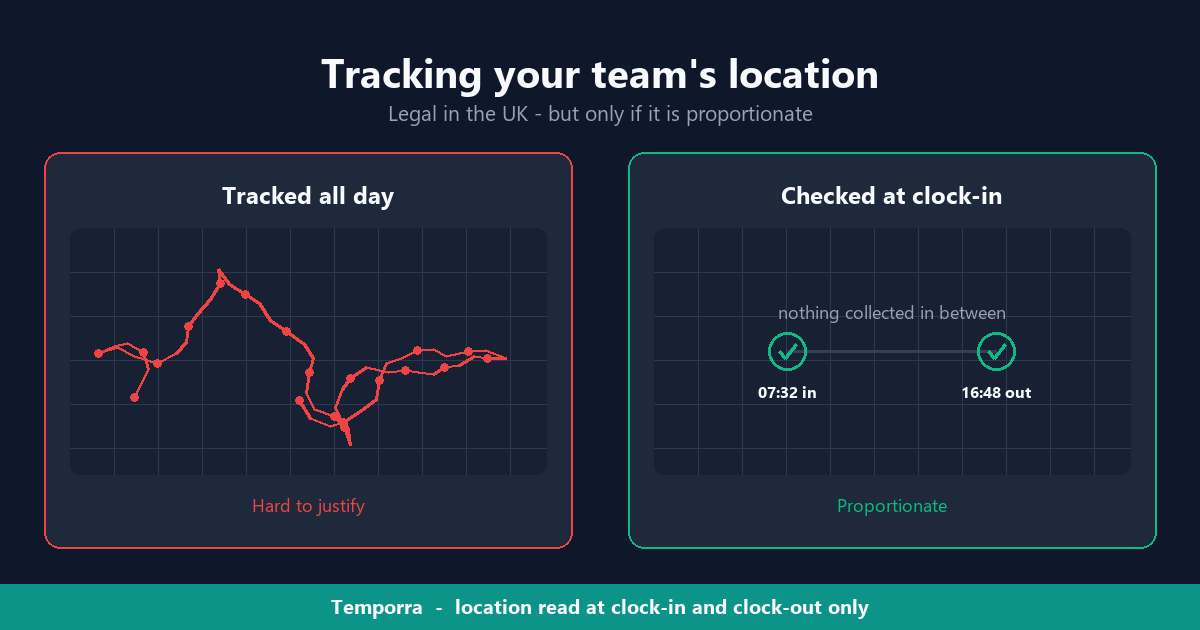
If the question is was this person on this site when they said they were, then a location check at the moment they clock in and the moment they clock out answers it completely. A continuous breadcrumb trail of their movements all day answers the same question, plus a great many questions you had no business asking. Under a necessity test, the second one is much harder to defend — precisely because the first one exists and works.
5. Stop at the end of the shift
This is the single most common failure, and it usually arrives through vehicle trackers rather than phones. A van fitted with a tracker and taken home overnight will keep reporting the worker's home address, their weekend, and their Sunday afternoon, unless someone deliberately stops it.
If a vehicle or device can be used privately, you need either monitoring that is switched off outside working hours or a privacy mode the worker can activate themselves. And you have to actually tell them it exists — a privacy button nobody knows about is not a safeguard.
Continuous tracking vs a check at clock-in
These are treated as very different things, and the distinction matters more than most employers realise when they are choosing a system.
| Continuous location tracking | Location checked at clock-in / out | |
|---|---|---|
| What it collects | An ongoing record of where someone is throughout the day | Two location readings per shift, at moments the worker initiates |
| Answers "were they on site?" | Yes | Yes |
| Also reveals | Routes, stops, breaks, detours, time at each location, patterns over time | Nothing beyond the two readings |
| Necessity test | Hard — a less intrusive option demonstrably exists | Straightforward, for attendance purposes |
| Out-of-hours risk | High; needs an active privacy mode | Low; nothing is collected between clock-out and the next clock-in |
| Worker expectation | Frequently experienced as surveillance | Broadly understood as proof of attendance |
There are genuine cases for continuous tracking — lone-worker safety, fleet routing, high-value load security. If one of those is your actual purpose, document it as your purpose and design around it. What does not work is deploying continuous tracking because it was in the box and then reaching for a safety justification when someone objects.
The biometric trap
If you are looking at attendance systems, you will be offered facial recognition or fingerprint clock-in, usually as the answer to buddy punching. It does solve that problem. It also moves you into a stricter legal category, and this is the part that vendors tend to skip.
Biometric data used to identify a specific person is special category data under UK GDPR. That means an Article 9 condition on top of your Article 6 lawful basis — a materially higher bar than location data.
The practical lesson is specific and easy to act on: if you use biometric clock-in, offer a real non-biometric alternative, make sure staff know about it, and make sure choosing it carries no penalty. An alternative that exists on paper but is discouraged in practice is not an alternative.
This is one reason Temporra ships kiosk mode with PIN access alongside facial verification. A shared tablet at the gate with a PIN is not a lesser fallback — for a lot of firms it is the primary route, and it means the biometric option is a genuine choice rather than a condition of employment.
How Temporra is built for this
Temporra is a UK time and attendance system for construction and field-service teams, and the location design follows the necessity principle deliberately.
- Location is read at clock-in and clock-out only. The app requests a single position fix at the moment a worker clocks on or off. It does not run a background location watch, so there is no trail between those two points and nothing is collected once someone has clocked out.
- Geofence check, not a map of movements. You set a radius around each job site — 200 metres, say — and the reading is compared against it. What you get is a pass or a flag against the site, which is what the attendance question actually needs.
- Facial verification with a PIN route. Kiosk mode with PIN access exists alongside it, so there is a genuine alternative to offer.
- A worker-facing privacy notice. Our privacy policy sets out plainly that location is captured only at clock-in and clock-out — so your staff can read for themselves what is and is not collected, rather than taking your word for it.
What that does not do is complete your paperwork. Temporra is the processor; you are the data controller for your workers' data, which means the lawful basis, the LIA, the DPIA, the privacy notice and the retention decision are yours. A well-designed tool makes those documents easier to write and much easier to defend. It does not write them.
A practical checklist
- Write down the specific question the monitoring answers. One sentence.
- Pick a lawful basis — legitimate interests for most attendance cases — and complete an LIA.
- Complete a DPIA. Involve workers or their representatives in it.
- Choose the least intrusive configuration that answers your question, and turn off anything else the system can do.
- Confirm nothing is collected outside working hours, or that a worker-controlled privacy mode exists and is publicised.
- Publish a worker privacy notice and a monitoring policy. Tell staff before it starts, not on the day.
- Set a retention period and enforce it. Attendance records tied to payroll have their own retention rules; a location log does not need to live forever because deleting it was never scheduled.
- Have an answer ready for a worker who asks for their data, or objects. They are entitled to ask, and the answer should not be improvised.
Frequently asked questions
Is it legal to track employees by GPS in the UK?
Yes — no law bans it. But it is personal data processing, so it is lawful only if you have a valid lawful basis, tell workers in advance, keep it proportionate to a genuine need, and can evidence that reasoning. Monitoring that is excessive, secret, or continues outside working hours is where employers come unstuck.
Do I need employee consent to use GPS clock-in?
Usually you should not rely on consent. The power imbalance between employer and worker means it is rarely freely given, and it can be withdrawn at any time. Legitimate interests, supported by a documented LIA, is the more robust route for attendance monitoring.
Do I need a DPIA before tracking workers' location?
In practice, yes. It is legally required where processing is likely to result in a high risk, and systematic location monitoring qualifies. The ICO's 2023 guidance recommends completing one before any worker monitoring regardless.
Can I track someone's location outside working hours?
Not without a very strong, specific justification that would be difficult to make out for ordinary attendance purposes. If a vehicle or device can be used privately, monitoring must stop outside working hours or offer a privacy mode the worker controls and knows about.
Is facial recognition for clocking in allowed?
It is held to a higher standard than location, because biometric data used for identification is special category data requiring an Article 9 condition. The Serco Leisure enforcement notice in February 2024 is the case to read. If you use it, offer a genuine non-biometric alternative such as a PIN, and make sure nobody is penalised for choosing it.
What do I have to tell staff?
Before monitoring starts: what is collected and when, why, your lawful basis, retention, who it is shared with, and how to exercise their rights. Put it in a privacy notice and a monitoring policy — and consult them first if you can.
The honest version
Most disputes about workforce tracking are not really about the technology. They are about proportionality and about being told. A firm that checks location twice a shift, wrote down why, and told everyone in advance is in a very different position from one that switched on everything the system offered and hoped nobody would ask.
The useful question is not "how much can I legally collect?" It is "what is the least I need to collect to answer my question?" — because the smaller that answer is, the easier it is to justify, the less you have to secure, and the fewer people you have to win round.
If you want to see what attendance verification looks like when it is designed to that principle, try it and read the privacy notice before you read the feature list.
Related reading
- How to stop buddy punching on UK construction sites
- The real cost of paper timesheets for UK construction firms
- How to track employee hours
Start a free 14-day trial · Book a demo
No card required. Flat monthly pricing by team size, every feature on every tier — see pricing.